
Both zinc die casting and aluminum die casting are matched to be used in various applications, and the advantageous option is based on the accuracy of the dimension, the complexity of the part, and production volume coupled with the need, rather than popularity of that material.
A significant presence of OEM engineers compromises as far as to using aluminum due to its lighter weight and perceived strength benefits. However, the fact is zinc tends to be better in precision, thin-walling, recreation of finer details, and cost efficiency with small-to-mid size parts in large volume production. Both processes are not always the best; which process behavior fits your real engineering and business limitations makes the right choice.
Zinc often presents superior total value in applications where tight tolerances, complex features or fast cycle times are passively important compared with minimizing mass. When you are weighing alternatives now you may begin by finding out what dimensions we must have in your part and how many days you need it each year–you will have most of the guesswork out of the way with these two.
(Internal link placement here – natural fit when you want to take the strengths of zinc:) To find out more about precision zinc capabilities, thermal stresses on tooling, and final part characteristics.
Comparison Table: Material & Process Fundamentals
| Category | Zinc Die Casting | Aluminum Die Casting | Application Impact |
| Melting Point | Low (~419°C) | High (~660°C) | Zinc enables faster cycles, longer tool life |
| Density | Higher (~6.6–7.0 g/cm³) | Lower (~2.7 g/cm³) | Aluminum wins for weight-critical designs |
| Fluidity/Flow | Excellent, fills thin sections easily | Good, but less than zinc | Zinc excels at complex, thin-wall geometries |
| Corrosion Resistance | Moderate to good (with plating) | Excellent (natural oxide layer) | Aluminum preferred for exposed outdoor use |
| Thermal Conductivity | Higher | Lower | Zinc better for heat dissipation in electronics |
| Typical Casting System | Hot chamber | Cold chamber | Zinc faster; aluminum more alloy-flexible |
Process Differences and Manufacturing Behavior
Hot chamber die casting provides a strong advantage in speed and stability to zinc whereas cold chamber only applies to higher temperature of aluminum but is complex.
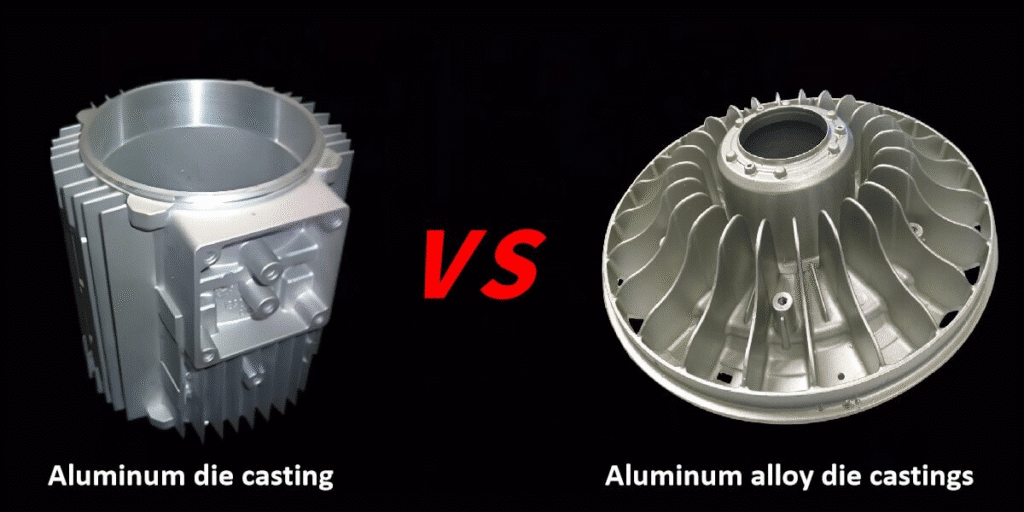
Molten zinc in hot chamber systems is maintained in the machine, enabling highly short cycle time and always producing a consistent shot. Cold chamber necessitates pouring aluminum into an individual sleeve with every cycle, increasing the duration and adding additional variables (temperature drop, dross).
Zinc cycles also have faster cycles, which make their energy per part less, and long-run dimensional repeatability better.
Detailed description of the mechanics is described in how zinc alloy die casting works. read how zinc alloy die casting works. To understand why the chamber type matters so much, see differences between hot and cold chamber die casting.
Dimensional Accuracy and Part Complexity
Zinc is routinely produced to narrower tolerances and smaller-thinner walls than aluminum and frequently removes secondary machining.
Lastly, the low shrinkage, (approximately 0.6) and easy flow of Zinc allow it to recreate finer details and achieve linear tolerances of up to ±0.0015 in/in on small lines. Sub- + 0.002 in /in is more difficult to keep consistent as Aluminum is more prone to shrink, more prone to thermal expansion, and will not behave as easily with additional measures.
Accuracy Comparison Table
| Feature | Zinc | Aluminum | Engineering Outcome |
| Typical Linear Tolerance | ±0.001–0.0015 in/in | ±0.002–0.003 in/in | Zinc reduces or eliminates post-machining |
| Minimum Wall Thickness | Down to ~0.5 mm (0.02 in) | ~1.0–2.3 mm (0.04–0.09 in) | Zinc enables lighter, more compact designs |
| Fine Detail Replication | Excellent (small radii, lettering) | Good, but limited by flow | Zinc ideal for cosmetic or functional details |
| Flatness/True Position | Superior due to low distortion | More prone to warp | Zinc better for mating interfaces |
Strength, Weight, and Structural Considerations
The strength-to-weight ratio of aluminum does well with load bearing, whereas the absolute strength and stiffness of zinc is usually adequate and even more than adequate with non-structural parts.
The tensile strength and impact resistance of zinc alloys is much better in smaller sizes, but the lower density of aluminum is decisive when each gram counts (e.g. in automotive brackets or aerospace housings).
In the case of most enclosures, connectors, or other hardware, the properties of zinc offer sufficient durability and the weight penalty is not an issue.
Cost Structure and Production Volume

Zinc is typically cost effective at moderate-to-large volumes due to shortening of cycles, prolonged life of tools and minimal additional operations.
The temperature also increases the rate of aluminum tooling wear, whereas the cost of machine-time is increased due to slower cycles. Zinc dies need not be changed as frequently: 5-10 times (up to 1M+ shots v. about 100k with aluminum), distribution of tooling amortization further.
Cost Comparison Table
| Cost Factor | Zinc | Aluminum | Decision Insight |
| Tooling Cost | Lower initial, but longer life | Higher wear → more frequent refurb | Zinc better for >100k–500k annual volume |
| Cycle Time | Faster (hot chamber, 30–60 s) | Slower (cold chamber, 60–120+ s) | Zinc lowers labor/energy per part |
| Material Cost/kg | Generally lower | Higher | Aluminum penalty grows with part size |
| Secondary Operations | Minimal (excellent as-cast finish) | Often required (machining, impregnation) | Zinc reduces total landed cost |
| Break-even Volume | Lower (~10k–50k units) | Higher (~50k+) | Zinc wins for mid-volume precision programs |
Typical Applications Where Zinc Is the Better Choice
Zinc is an advantage when precision, complexity, and cost-per-part considerations in volume are of priority, and not as raw weight considerations.
Examples Small electronic housings, cosmetic hardware, automotive interior bracket, medical device components, and high-volume connectors anywhere thin walls, tight fits, fine features dictate functionality or appearance.
Typical Applications Where Aluminum Is the Better Choice
When it comes to larger, structural, or weight sensitive parts, aluminum is used to add value such as thermal resistance and natural corrosion protection.
Consider engines brackets, transmission casings, heat sinks in EVs, lights or lighting fixtures, and outdoor enclosures–situations where the tradeoffs in the process of mass reduction justify the outcome.
Common OEM Mistakes When Comparing Zinc and Aluminum
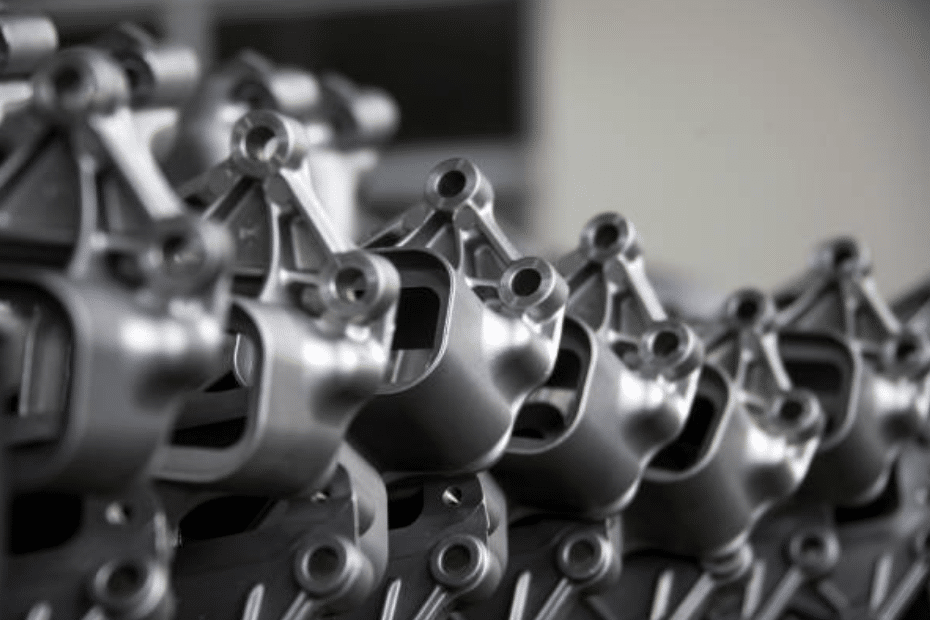
The most common mistake is to think that always going lighter is best but not to have a quantitative understanding of the overall system impact, many programs would overpay the weight-plus of aluminum in comparison with zinc to maintain strength and tolerance requirements at lower cost.
The other trap: to use cost per kilogram as the determining measure, rather than landed part cost (tooling + cycle time + finishing). Lastly, neglecting volume, the high-mix/low-volume is insensitive to the fact that volume (aluminum) is more economical as parts.
Conclusion — The Best Choice Is Application-Specific
None of the alloys and processes prevails. Before making a decision, consider your part functional needs (tolerance, wall thickness, load, environment), manufacturing targets (volume, schedule) and the total picture of costs (tooling amortization, ancillary processes, risk of lower quality).
The trade-off mentality in industry weighing weight versus precision, speed versus strengthening, etc., is effective solutions than adhering to industry failures. The process selected will be an asset and not a compromise when handled appropriately.