
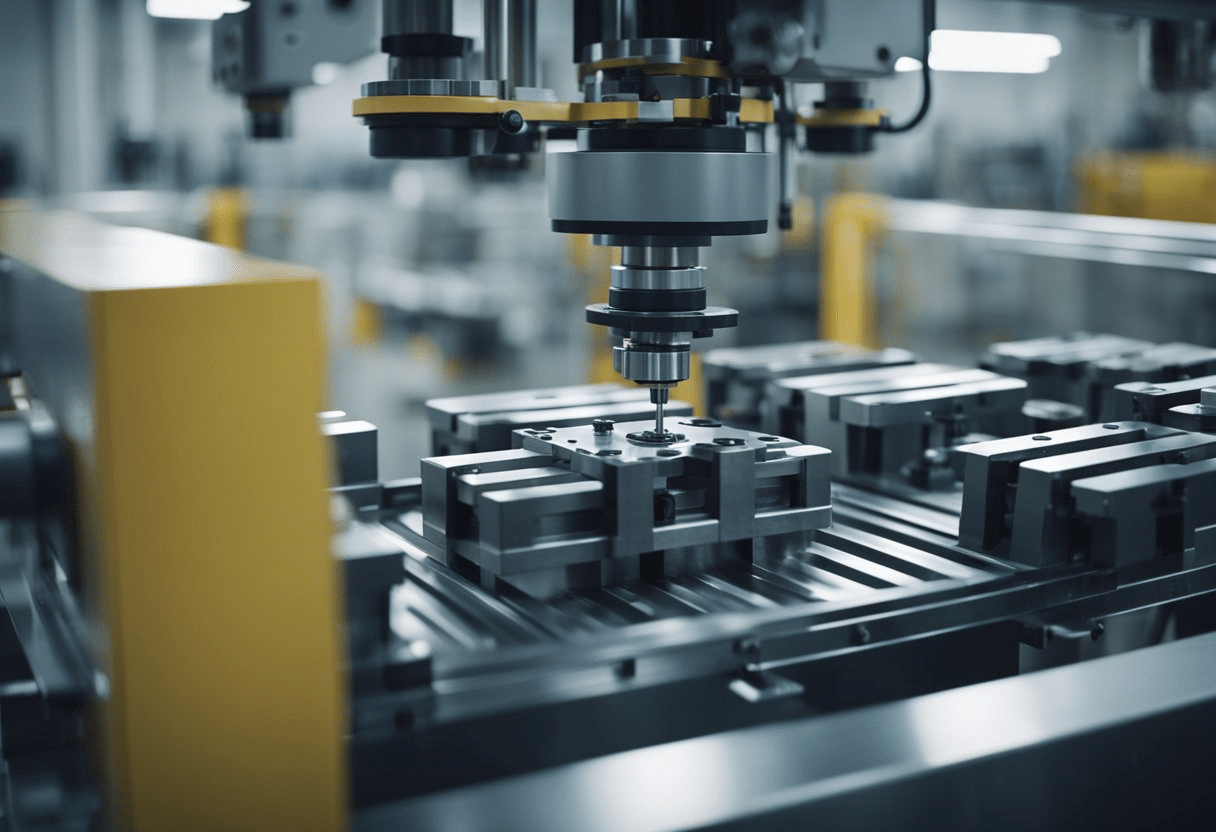
CNC Machining Services

Precision CNC Machining Services for Custom Metal Parts

Zhongyuan provides custom CNC machining services for high-precision metal components, supporting prototypes, low-volume runs, and mass production with stable tolerances, reliable quality control, and in-house finishing capabilities.

  • 20 CNC machining centers
  • In-house machining, finishing, and inspection
  • OEM/ODM support for global customers
  • Experience in automotive, electronics, lighting, and industrial parts
About Our Process

Custom CNC Machining for Precision Manufacturing Projects

At Zhongyuan, we provide custom CNC machining services for precision metal parts used in demanding industrial applications. Our team supports both standalone CNC machined parts and secondary machining for die-cast components, helping customers improve dimensional accuracy, assembly fit, and surface consistency.

With in-house CNC machining, deburring, polishing, coating, assembly, and inspection, we manage the full production workflow under one roof. This integrated manufacturing process helps reduce lead time, improve quality consistency, and simplify supplier coordination for OEM and ODM projects.

What We Offer

Our CNC Machining Capabilities

Our CNC machining services are designed for customers who need repeatable quality, flexible production support, and reliable communication from sampling to shipment. We work with custom drawings, 3D files, and application requirements to produce parts that match real assembly and performance needs.

01

CNC Milling

Complex geometries, flat surfaces, slots, pockets, and precision features machined to specification.

02

CNC Turning

Shafts, cylindrical parts, housings, threaded parts, and rotational components with tight tolerances.

03

Drilling & Tapping

Drilling, tapping, boring, and precision hole machining for assembly-critical features.

04

Secondary Machining

Post-casting CNC operations for aluminum and zinc die-cast parts to achieve critical dimensions and surface requirements.

05

Deburring & Finishing

Surface preparation, deburring, and finishing coordination integrated with the machining process.

06

Prototype to Volume

Prototype development, pilot production, and scalable volume manufacturing under one production system.

Typical Products
  • Housings
  • Brackets
  • Covers
  • Bases
  • Structural Metal Parts
  • Decorative & Functional Hardware
Material Capabilities

Materials We Commonly Machine

We machine a range of metal materials based on part function, geometry, tolerance, and finishing requirements. For many customer programs, aluminum and zinc alloy are the most common materials because they offer a good balance of machinability, weight, strength, and appearance.

For customers using die casting plus post-machining, we also provide CNC secondary operations to add critical dimensions, threaded features, sealing faces, and assembly-related details after casting.

  • Aluminum Alloys
  • Zinc Alloy
  • Steel
  • Stainless Steel
  • Brass
  • Other custom metals based on project requirements
Production Capacity

From Prototype to Mass Production

We support customers at different stages of product development, from early samples to full production orders. Whether you need prototype CNC machining for validation or stable batch production for long-term supply, we build the process around your drawing, application, and delivery requirements.

Our engineering and production teams review part structure, key tolerances, machining sequence, and finishing requirements before production begins. This early review helps reduce manufacturability risks, improve efficiency, and support smoother communication throughout the project.

  • Prototype and sample machining
  • Small-batch trial production
  • Medium- and high-volume manufacturing
  • Process review based on drawings and application needs
  • OEM/ODM production support
  • Packaging arranged for export shipment
Quality Assurance

Quality Control for Precision CNC Parts

Quality control is essential in CNC machining, especially for parts used in automotive systems, electronics assemblies, lighting components, and other functional applications. Our inspection workflow is built to help verify dimensional accuracy, material consistency, and surface quality at different stages of production.

We review customer drawings, key dimensions, appearance requirements, and assembly-critical features throughout production. By combining machining control with in-house inspection, we help customers reduce variation, improve part consistency, and maintain confidence in delivered quality.

Inspection Equipment
  • Coordinate Measuring Machine (CMM)
  • X-Ray Flaw Detector
  • 3D Scanner
  • Microcomputer Tensile Testing Machine
  • Direct-Reading Spectrometer
Certifications
IATF 16949:2016 ISO 14001:2015 D-U-N-S® 554551629
Why Zhongyuan

Why Work With Zhongyuan

Zhongyuan is more than a machining supplier. We are a manufacturing partner with experience in die casting, CNC machining, mold development, finishing, assembly, and export-oriented production management.

01

Integrated Under One Roof

Die casting and CNC machining in a single facility, enabling faster coordination between machining, finishing, and inspection stages.

02

Die-Cast Post-Machining

Support for both custom machined parts and die-cast secondary machining, covering the full spectrum of metal part manufacturing.

03

Multi-Industry Experience

Proven track record across automotive, electronics, lighting, home appliances, and industrial hardware applications.

04

In-House Quality Control

Comprehensive inspection with CMM, 3D scanning, X-ray, and spectrometry equipment for consistent, verifiable quality outputs.

05

OEM/ODM Ready

Experienced in OEM and ODM production for overseas buyers, with export packaging and shipping coordination in place.

06

Process Management

Structured production workflows with drawing-based reviews, in-process control, and clear project communication at every stage.

Our team focuses on practical manufacturing execution, clear communication, and long-term production reliability. For customers sourcing precision metal parts from China, this combination is often just as important as machining capability itself.

Markets Served

Industries We Serve

Our CNC machined parts are used across multiple industries that require stable dimensions, reliable material performance, and consistent surface finish. We understand that each application has different priorities, from structural strength and appearance quality to assembly precision and durability.

  • Automotive Parts
  • Electronics & Telecommunications
  • Lighting Components
  • Home Appliances
  • Machinery & Equipment
  • Cosmetic & Decorative Hardware

Because we also support die casting and finishing processes, we can help customers develop complete part solutions rather than isolated machining-only steps.

How We Work

Our Manufacturing Workflow

A clear and controlled production workflow is important for both quality and delivery. Our CNC machining projects typically follow a structured process so that technical requirements are reviewed early and production stays aligned with customer expectations.

  1. STEP 01
    Drawing or Sample Review
  2. STEP 02
    Process Evaluation & Quotation
  3. STEP 03
    Sample or Prototype Production
  4. STEP 04
    CNC Machining & In-Process Control
  5. STEP 05
    Deburring, Finishing & Secondary Ops
  6. STEP 06
    Final Inspection & Packaging
  7. STEP 07
    Delivery for Approval or Mass Supply

This workflow helps us maintain traceability, improve communication efficiency, and support more stable project execution from start to finish.

FAQ

Frequently Asked Questions

What CNC machining services do you offer?
We provide CNC milling, CNC turning, drilling, tapping, boring, and secondary machining for custom metal parts. Our service also includes deburring, finishing coordination, inspection, and production support from prototypes to batch orders.
Can you machine die-cast parts after casting?
Yes. We provide secondary CNC machining for aluminum and zinc die-cast parts to improve dimensional accuracy, create threaded features, machine sealing surfaces, and support assembly-critical requirements.
What materials do you commonly machine?
We commonly machine aluminum, zinc alloy, steel, stainless steel, and brass. Material selection depends on part design, tolerance, application environment, and finishing requirements.
Do you support OEM and ODM projects?
Yes. We support OEM and ODM manufacturing projects and can work from customer drawings, 3D files, samples, and technical requirements.
Can you handle both prototypes and mass production?
Yes. We support prototype machining, small trial runs, and long-term production orders. Our in-house production system helps us manage different order volumes more efficiently.
How do you control the quality of CNC machined parts?
We combine drawing review, in-process control, and final inspection with equipment such as CMM, 3D scanning, X-ray inspection, and material analysis tools to support dimensional and quality consistency.
What industries do you supply?
We supply CNC machined parts for automotive, electronics, lighting, home appliance, machinery, and decorative hardware applications.
Can you provide finishing after machining?
Yes. We can support finishing-related processes through our in-house production chain, including deburring, polishing, coating, assembly, and packaging.
FAQ

Frequently Asked Questions

What CNC machining services do you offer?
We provide CNC milling, CNC turning, drilling, tapping, boring, and secondary machining for custom metal parts. Our service also includes deburring, finishing coordination, inspection, and production support from prototypes to batch orders.
Can you machine die-cast parts after casting?
Yes. We provide secondary CNC machining for aluminum and zinc die-cast parts to improve dimensional accuracy, create threaded features, machine sealing surfaces, and support assembly-critical requirements.
What materials do you commonly machine?
We commonly machine aluminum, zinc alloy, steel, stainless steel, and brass. Material selection depends on part design, tolerance, application environment, and finishing requirements.
Do you support OEM and ODM projects?
Yes. We support OEM and ODM manufacturing projects and can work from customer drawings, 3D files, samples, and technical requirements.
Can you handle both prototypes and mass production?
Yes. We support prototype machining, small trial runs, and long-term production orders. Our in-house production system helps us manage different order volumes more efficiently.
How do you control the quality of CNC machined parts?
We combine drawing review, in-process control, and final inspection with equipment such as CMM, 3D scanning, X-ray inspection, and material analysis tools to support dimensional and quality consistency.
What industries do you supply?
We supply CNC machined parts for automotive, electronics, lighting, home appliance, machinery, and decorative hardware applications.
Can you provide finishing after machining?
Yes. We can support finishing-related processes through our in-house production chain, including deburring, polishing, coating, assembly, and packaging.

Precision CNC Machining Services for Custom Metal Parts

From prototypes to low and medium-volume production, we deliver tight-tolerance CNC machined parts with consistent quality and fast turnaround.

Custom CNC Machining Services for High-Precision Components

Our CNC machining services are designed to support customers who require high dimensional accuracy, stable quality, and reliable delivery. With advanced CNC machining centers and experienced engineers, Zhongyuan & JiaZhan provide custom machined metal parts for automotive, electronics, lighting, medical, and industrial applications.

CNC Milling for Complex Geometries

Our CNC milling services support complex shapes, precision pockets, and multi-surface machining. Ideal for housings, brackets, structural components, and custom industrial parts.

Capabilities:

  • Aluminum & zinc alloy milling

  • Tight tolerance control

  • Stable batch consistency

CNC Turning for Cylindrical Precision Parts

We offer CNC turning services for shafts, pins, bushings, and rotational components with smooth surface finish and dimensional accuracy.

Capabilities:

  • High concentricity control

  • Consistent surface quality

  • Suitable for low to medium volumes

Strong In-House CNC Machining Capability

Zhongyuan & JiaZhan operate CNC machining as an in-house manufacturing capability integrated with die casting and mold fabrication. With over 20 CNC machining centers and automated grinding and finishing equipment, we maintain stable accuracy, fast turnaround, and consistent quality.

Our CNC processes support tight tolerances up to ±0.01 mm, making them ideal for precision metal components used in automotive, electronics, lighting, and industrial applications. In-house production allows us to shorten lead times and ensure reliable, repeatable results from prototype to production.

CNC machining centers
0 +
years of manufacturing experience
0 +
countries served worldwide
0 +
publicly listed company clients
0 +

CNC Machining Surface Finishing Options

We provide a full range of surface finishing services in-house to improve appearance, corrosion resistance, and functional performance.

As Machined

The machined finish comes directly from the CNC machine, offering a cost-effective option that includes visible tool marks.

Anodizing

Anodizing enhances corrosion resistance and wear durability, while also enabling color dyeing, making it ideal for aluminum components.

Polishing

Polishing creates a high-gloss finish by reducing surface roughness, thereby improving the visual appeal of metal parts.

Sand Blasting

Sand blasting employs pressurized sand or other abrasive media to clean and texture surfaces, producing a consistent matte finish.

Brushed Finish

A brushed finish produces a unidirectional satin texture that helps minimize the appearance of marks and scratches on the surface.

Powder Coating

Powder coating provides a durable, wear-resistant layer with a wide range of color and texture options, ideal for various surfaces.

Electroplating

Electroplating applies a thin metal coating to parts, enhancing wear resistance, corrosion protection, and surface conductivity.

Black Oxidize

Black oxide is a conversion coating for ferrous metals that enhances corrosion resistance and reduces light reflection.

Electropolish

Electropolishing is a chemical treatment that smooths and brightens surfaces while enhancing corrosion resistance.

Alodine

Alodine coating offers corrosion protection and enhances paint adhesion, primarily applied to aluminum surfaces.

Heat Treatment

Heat treatment changes the mechanical properties of metal to improve its hardness, strength, or ductility.

Tolerances for CNC Machining

Standard capabilities for milling and turning. We can also meet tighter tolerances based on your drawings and GD&T.

Quality-Controlled

Our CNC processes follow industry standards to ensure consistent accuracy and reliable fit with mating components.

Description
Item Specification
General Tolerances Metals: ISO 2768-m
Plastics: ISO 2768-c
Precision Tolerances Fioria can manufacture and inspect parts with strict tolerances according to your drawing specifications and GD&T annotations, including tolerances tighter than +/- 0.001 inches.
Min Wall Thickness 0.5mm
Min End Mill Size 0.5mm
Min Drill Size 1mm
Maximum Part Size CNC Milling: 4000×1500×600 mm
CNC Turning: 200×500 mm
Maximum Part Size CNC Milling: 5×5×5 mm
CNC Turning: 2×2 mm
Production Volume Prototyping: 1–100 pcs
Low volume: 101–10,000 pcs
High volume: Above 10,001 pcs
Lead Time 5 business days for most projects.
Delivery of simple parts can be as fast as 1 day.

Get Reliable CNC Machining from an Experienced OEM Manufacturer

In-House Quality Control for CNC Machined Parts

All CNC machined parts are inspected in our dedicated in-house quality control center to ensure compliance with drawing specifications, GD&T requirements, and applicable industry standards.

We apply inspection checks at key stages of production, including first article inspection and final pre-shipment verification, to maintain consistent dimensional accuracy and product reliability.

Inspection equipment includes:

  • Coordinate Measuring Machine (CMM)

  • 3D optical scanner

  • X-ray flaw detection system

  • Spectrometer and mechanical testing equipment

Every part is verified before shipment. Inspection reports can be provided upon request to support quality traceability and customer approval.

Rapid Prototyping

CNC rapid prototype machining is ideal for producing engineering or production prototypes that closely match the final product in both look and function. At Fioria, we provide instant quotes and quick delivery, ensuring you receive accurate, high-quality CNC machined prototypes tailored to your requirements.

Low Volume Manufacturing

Low-volume CNC machining often serves as a bridge between prototyping and mass production for new and emerging products. With Fioria, this process is made easier, more efficient, and cost-effective, enabling you to scale production quickly while maintaining strict quality standards.

End-use Production

CNC production machining is the ideal choice for efficiently producing thousands of parts or more. Utilizing a wide range of materials along with automation and multi-axis technology, Fioria ensures high-volume production with tight tolerances, exceptional dimensional accuracy, high reliability, and quick turnaround times.

Why Choose Us

/01 High Quality Parts

Our ISO-certified factories perform in-process inspections and post-production testing to ensure every custom molded part is accurate and consistent, regardless of complexity.

/02 Fast Lead Time

Keep your projects on track with Fioria. Our local workshops and state-of-the-art equipment ensure fast turnaround times to meet your deadlines.

/03 Engineering Support

Rely on us anytime, anywhere for your CNC machining needs. Our experts offer support to optimize design efficiency and quality.


FAQs

CNC machining is widely applied across various industries.

In the automotive and aerospace fields, it is used to produce precise engine parts, structural components, and other complex elements.
The medical sector utilizes CNC for manufacturing devices, implants, and surgical tools.
In electronics, CNC plays a key role in making electronic housings, circuit boards, and connectors.
Machine tool manufacturers depend on CNC to create intricate molds, dies, and machine parts.
Moreover, CNC is essential for custom part fabrication, prototyping, woodworking, and more, ensuring consistent quality and high precision.


Advantages of CNC Machining

Precision and Consistency: CNC machining delivers high accuracy and consistent part replication, essential for complex designs with tight tolerances.

Minimized Human Error: Automation reduces the risk of human mistakes, improving overall production quality.

Speed and Efficiency: Automated processes enable faster production cycles, resulting in quicker turnaround times compared to manual methods.

Wide Material Compatibility: CNC machines can process a broad range of materials such as metals, plastics, and composites, providing versatility for different applications.

Seamless Software Integration: Advanced CNC software allows for rapid design modifications and updates, supporting fast prototyping and easy customization.

Cost Efficiency for Large Volumes: Although initial setup costs are higher, the cost per unit drops significantly with increased production quantities, making it economical for mass manufacturing.

Manufacturing Process: 3D printing is an additive technique that constructs parts layer by layer using materials such as plastic or metal. Conversely, CNC machining is a subtractive method that shapes the final product by removing material from a solid block.

Material Efficiency: 3D printing reduces waste by using only the necessary material to create the part, while CNC machining tends to generate more waste due to its subtractive approach.

Speed and Cost: For small production runs and intricate designs, 3D printing often offers faster turnaround and greater cost-effectiveness. CNC machining is better suited for higher volumes and applications demanding superior precision and material strength.

Surface Finish and Tolerances: CNC machining generally delivers superior surface finishes and tighter tolerances compared to 3D printing.

John T. Parsons is widely recognized as the father of CNC machining. In the late 1940s, he developed the first numerical control methods and applied them to manufacturing helicopter rotor blades. Collaborating with engineer Frank L. Stulen, Parsons devised the concept of using punched tape to control machine tools. This breakthrough laid the foundation for CNC (Computer Numerical Control) technology. Their pioneering efforts ultimately resulted in the creation of the first CNC machines in the 1950s, transforming manufacturing by enhancing the precision, efficiency, and consistency of machining processes.

G and M codes are the programming languages used to control CNC machine tools in CNC machining. G-codes mainly specify the machine’s movements, including linear interpolation, circular motions, and other functions related to the tool’s path. In contrast, M-codes manage machine operations not directly connected to the tool’s movement, such as powering the machine on or off, starting or stopping the spindle, and controlling the coolant. Together, G and M codes form a complete set of instructions that CNC machines execute to manufacture parts accurately and efficiently.

CNC machining is well-known for its capability to deliver high precision and tight tolerances, which are crucial for producing complex and detailed parts. Standard CNC machining typically maintains tolerances within ±0.01 inches (±0.127 mm), and RapidDirect uses these standardized tolerances by default unless otherwise specified. For more demanding precision, advanced CNC machines can achieve tolerances as tight as ±0.0005 inches (±0.0127 mm) under ideal conditions. The achievable tolerance varies depending on factors such as the material, part geometry, size, and the specific CNC machine employed. This precision capability makes CNC machining the preferred method for industries requiring highly accurate components, including aerospace, medical, and automotive sectors.

A machining center is a sophisticated CNC machine capable of performing multiple machining operations such as milling, drilling, and tapping in a single setup. This integration improves efficiency and precision by eliminating the need to move parts between separate machines. Equipped with a tool turret or magazine holding various tools, machining centers enable automatic tool changes controlled by the CNC system. This feature allows for quick transitions between different operations, streamlining the production process. Machining centers are commonly used for complex parts requiring precise machining from multiple directions, making them essential in today’s manufacturing industry.

Certainly! At Fioria, we have the capability to produce over 10,000 varied prototypes each month, from simple to complex designs. Our production is backed by more than 200 advanced CNC machines. Additionally, our team of over 100 experienced technical professionals guarantees precision and quality in every project. This robust infrastructure enables us to efficiently handle large-scale demands, making us a dependable partner for all your CNC machining requirements. Whether your project is large or small, our resources are dedicated to delivering excellence.

The cost of our CNC machining service varies depending on the specific characteristics of your project, such as its design complexity and tolerance requirements. The machining time required for the selected material also plays a significant role in determining the price. For example, if a part’s combined machining and material cost is $2, plus a $200 setup fee, the total cost for a single part would be $202. However, if you order 200 identical parts, the cost per unit would drop to just $3! Learn more about CNC machining costs.

At Fioria, we recognize the varied needs of our customers, from single prototypes to large production volumes. Therefore, we do not impose a strict minimum order quantity (MOQ). Whether you need a single machined part or thousands, we have the capabilities to deliver customized solutions that fit your exact requirements. Our flexible approach guarantees that every client, no matter the order size, receives exceptional service and quality.

The lead time for receiving a CNC machined part from Fioria depends on various factors, including the part’s design complexity, the chosen material, and our current production schedule. CNC machining is recognized for its speed, especially with simpler parts, enabling fast turnaround times. In some cases, parts can be delivered within just one day after the machining setup is finalized. For the most accurate and personalized time estimate, we recommend reaching out to us directly for a detailed quote. This allows us to provide a precise delivery timeframe based on your specific project needs.

Scroll to Top