
Change in mass production is not a head-ache here and there, it is the largest danger of cost, delivery and trust of the customer. At scales consisting of thousands and tens of thousands of parts per month, even minor discrepancies are magnified and tolerances add, wastes add, and yields decline.
Variation is still hunted after by many teams trying to narrow the inspection requirements or increase the number of checkpoints to the end of the line. However, this is where the tough fact that we have come to know after many years of operation of the high volume CNC lines is that downstream inspection cannot remove upstream instability. It finds the damage when the damage has occurred.
Variation is minimized through efficient CNC process control that stabilizes the production of parts, rather than by discarding the variability in the result afterwards. One can add predictability to the system itself by locking the variables, which are actually causing deviation: tool paths, fixturing, parameters, thermal conditions. The outcome is consistent output shift-shift, variant-variant, without resorting to heroic sorting, or reworking.
Why Variation Originates From Process Instability, Not Individual Errors
Indeed, variation in mass production does not often arise out of an incident such as a bad tool, or a momentary failure. It is the result of instability in systems, of little, resolvable fluctuations into which large volumes are deposited, which grow over time.
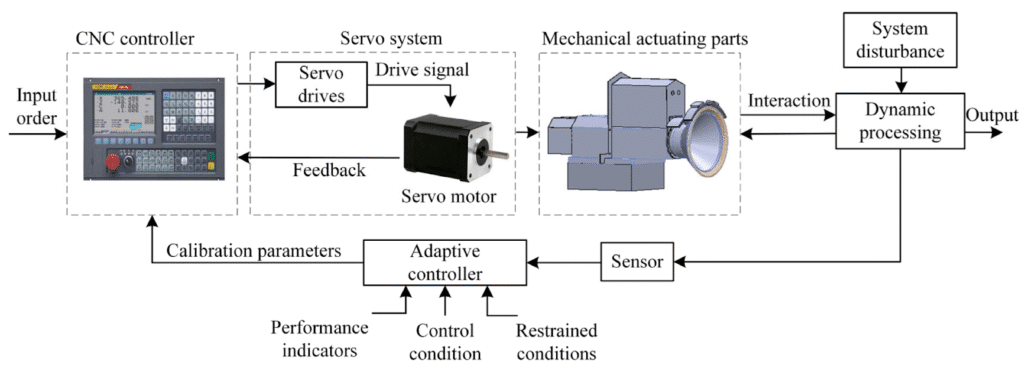
Random defects (a chipped insert, a missed chip in the insert) can be seen and remedied. Systemic variation is manifested by gradual changes: in the form of parts moving 0.02 mm per 500 parts due to non-compensated thermal growth in the spindle, or surface finish decreasing with changes in coolant concentration across shifts. These are no mistakes, these are inputs to processes which are out of control.
With large-scale production, the arithmetic is cold. The drift of 0.005 mm per part will give 5 mm overall drift on 1,000 parts. This may be obscured by operator corrections which are temporary, but are not scalable: fatigue, shift changes, and alternative interpretations all add still more noise. The only long term solution is to ensure that stabilization of the process is done at the uphill end in such a way that variation is never given the opportunity to increase.
This is why mature shops make enormous investments in regulated manufactures. When evaluating partners for professional CNC machining services in China, look for evidence that they treat process stability as a core system property—not an afterthought.
Core Elements of CNC Process Control in Mass Production
In mass production, the stability of the CNC processes is ensured through a deliberate control of the variables that have the greatest effects on the repeatability. Tweaked in a random manner, or in a fashion that is best-effort, just do not scale to large volumes.
The table below highlights the key control factors that we use in our everyday life to maintain the variation at a tight point:
| Process Control Element | Controlled Variable | Impact on Variation |
| Program standardization | Tool paths & sequence | Eliminates programmer-to-programmer differences; prevents path-induced deviation |
| Fixture repeatability | Part location & clamping force | Ensures consistent datum; reduces setup-to-setup positional scatter |
| Parameter locking | Feed, speed, depth of cut | Prevents drift from ad-hoc changes; maintains chip load and tool life consistency |
| Thermal compensation | Spindle & environment temp | Counters growth/contraction; keeps tolerances stable over long runs |
| Tool life management | Wear prediction & replacement | Avoids sudden surface or dimensional jumps from degraded tools |
| Coolant & chip control | Concentration, flow, removal | Minimizes built-up edge and thermal shock; sustains finish and dimension |
All the elements collaborate to reduce the natural process spread. Considering that, as an example, locking parameters is not micromanagement, but physics. The forces of cutting and heat input entirely depend on the feed and speed. Allowing them to be tuned by operators on-the-fly leads to uncontrolled variables which can only be responded to later.
As a matter of fact we standardize programs using version control, fixtures using repeatability tests (less than 0.005 mm), and parameters using CNC logs. This results in the creation of a slender predictable distribution when operating various alloys or families of parts.
Process Control Challenges in Thin-Wall Die Cast Parts
Die-casts with a thin wall increase all sources of variation during the process as minor variations become significant inconveniences. Wall thickness less than 2.53 mm lose their rigidity quickly, and so are hypersensitive to cutting forces, heat, and vibration.
The thinner the thinner the wall is; there is more deflection even with moderate feeds. That deflection alters effective depth of cut, causes the chatter, and gives rise to a self-defeating loop: increased vibration causes increased uneven removal causes increased surface and dimension scatter causes poor surface and dimension scatter. Thermal effects are worse as well, localized heating would cause expansion, which in turn bends unsupported sections before part cools and settles.
These effects multiply thousands of times in mass production. On thicker sections a stable process may suddenly be interrupted by the same parameters being exposed to a 1.8 mm wall. Managing variation in this case requires the use of lighter radial engagement, adaptive tool paths, purposeful fixturing (vacuum/low force clamps), and frequently step-down machining that balances material removal to stability.
To have a more in-depth look at those particular challenges, see our detailed guide on CNC machining thin-wall parts.
CNC Process Control for Cosmetic and Decorative Components
Cosmetic and ornamental die-cast items require surface consistency which extends way beyond maintaining dimensions. Any variation in tool engagement and vibration or thermal loading is immediately reflected as visible chatter marks, tool lines or uneven sheen, as are defects that functional parts may accept.
Control of mass production variation of such parts conventionally involves reducing the cause of micro-variation: constant spindle speed in order to avoid harmonic effects, constant coolant delivery in order to prevent staining or accumulation of edge, and locked parameters in order to maintain uniformity of surface footage. Minor tool wear can cause a sufficient change in the Ra values to not pass visual inspection.
The focus is no longer on pure dimensional CpK, but on a tight process window of aesthetics. On our finish runs, with feeds that are conservative and new tools, we will normally accept a cycle that is slightly longer in order to preserve appearance.
Learn more about tailored approaches in our post on CNC for cosmetic components.
Different Process Control Needs for Structural Components
Various Process Control Requirements of Structural Components.
The importance of structural components leans towards mechanical reliability and functional stability rather than on the perfection of a surface. The objective is steady strength, fatigue resistance and fit, that is, variation control focuses on the control of critical dimensions, prevention of stress raisers as well as retention of material properties.
In this case, permissible process scatter is commonly broader on non-critical parts but needs to be brutally tough on load-bearing parts. Control is based on repeatable fixturing to defend datums, thermal control to eliminate residual stress and toolpath policies that will not scratch-off or underscore high-stress areas.
Structural parts also sometimes accept visible tool marks when mechanical performance is guaranteed, where the parts would not otherwise. The criteria of evaluation are not similar: CpK on important features beats homogenous Ra in the whole part.
See our comparison guide for more: machining requirements for structural parts.
Why Inspection Alone Cannot Reduce Production Variation
Inspection is not sufficient in reducing production variation since it takes place after the variation is already developed. It has a time delay in it: the flaws are produced in the process of machining, and they are discovered a few minutes or hours or shifts later.
By the time it is detected hundreds or even thousands of parts might have the identical problem. The only solution is rework or scrap, which is costly, intervening, and responsive. It involves actually closing the loop at the process level where the variation may be controlled thus preventing repetition of the issue by the next part.
Feedback should also be in real or near-real-time (in-process probing, power monitoring, thermal sensors), but not post-mortem. Final inspection is a poor way to rely: it is not only more expensive but it will also tie up capacity better and conceal root causes rather than remove them.
How OEMs Should Evaluate CNC Process Control Capability
In qualifying suppliers to high-volume CNC work, consider their capability of avoiding variation, rather than only detecting it. Demand signs of fully developed process control systems as opposed to slick inspection reports.
Look for:
- Procedures of parameter lock-down and evidence that it is done (CNC program comments, change logs)
- Record of the qualification of the fixation on a batch-to-batch basis.
- Thermal compensation programs and environmental control reports.
- SPC charts on major characteristics, not only first-article data, of production runs of considerable length.
- Recordings of proactive measures to be undertaken when specs are exceeded in the process of drifting.
A good mate will demonstrate even distributions which are narrow and stable even when changing shifts, as well as material heats. They stop variation upstream and allow inspection to be confirmation and not correction.
Conclusion — Stable Processes Create Stable Output
CNC process control in mass production is not a process of defect detection, but an aversion of the environment that implies creation of defects. The first step towards reducing variation in CNC machining is stabilizing the system – parameters, settings, thermal behaviour, tooling, etc. – in such a way that the output is predictable irrespective of volume, shift or slight variation.
Inspection is fine, however it is a safety measure not the basis. The actual leverage can be seen in having the process engineered to reduce the spread within the first place. That is how large volumes of lines can get quality that is consistent, reduced cost, and reduced lead times without the need to firefight.
By managing variation at the source, all the downstream is both easier and more dependable, as well as very cheap.