
The distinguishing attribute of zinc alloy die casting includes complex, high-precision metal components manufactured with tolerances that are usually tight than most other casting technologies- no additional manufacturing operations or cost tend to be incurred. However, several OEM engineers and quality departments overinspire what additional production can and should be done continuously. They believe that tougher requirements on the drawing will make people follow it with more strict inspection. In practice, the tolerances that can be attained in zinc alloy die casting depend upon process stability, quality of tooling and thermal control and not upon the ultimate values. Even a fairly tight tolerance is not economical and not achievable in even thousands of shots, with unstable processes.
End-of-line gauging will not give the root causes of variation. Only an upstream engine has the real, actual, control: repeatable and constant injection, die temperature balance, predictable cycles and dies that are engineered and serviced to predict their thermodynamic behavior. Professional zinc die casting in China can usually perform well in this area since high-volume experience combined with in-house tooling skills can offer reliable partners to companies.
What “Typical Tolerances” Mean in Zinc Die Casting
In die casting of zinc, typical tolerances are numbers required to be held within manufacturing many times over – not in ideally perfect cases of a single shot. Control Nominal tolerances are provided by the print; realistically tenable tolerances are what the process can actually achieve under controlled conditions; repeatable tolerances are those that are statistically repeatable over time (possibly at 6 -8 sigma confidence).
The geometry of the part is gigantic. The parting line or features between slides feature tighter than half-line features. The shrinkage at low concentration of zinc (approximately 0.6 per cent) is, nevertheless, not an insignificant variation with wall thickness, ribbing, and heat sinking. Assessment of capability on a statistical basis (called capability studies Cpk/Cpk) is crucial; without knowledge of variation, a single statistical measure of capability can be very insignificant.
| Tolerance Type | Definition | Practical Meaning for OEMs |
| Nominal | Specified on the engineering drawing | The target; doesn’t indicate producibility |
| Achievable | Best demonstrated in trials or short runs | Possible under ideal setup, but may require extra cost or die adjustments |
| Repeatable | Held consistently in volume production (statistical control) | What matters for cost, delivery, and risk; aim for Cpk ≥ 1.33 on critical dimensions |
Typical Tolerance Ranges in Zinc Alloy Die Casting
With small parts, zinc alloys (such as Zamak 3, Zamak 5, ZA-8) consistently attain linear tolerances of the order of ±0.0010002 in per inch (±0.025point 8 mm per 25 mm) due to the low shrinkage rates and the good fluidity. PLUS ±0.05mm Small features usually contain as-cast. These are better than aluminum die casting where tolerances are usually more relaxed due to more solidification shrinkages.
There are mechanics widening tolerances on parting lines, or in movable die features, by size, or by parting lines. Geometric tolerances (flatness, perpendicularity) have similar patterns and require more uniformity of the die temperature.
| Feature Type | Typical Tolerance Range | Notes |
| Linear (same die half, <25 mm) | ±0.05 mm (±0.002 in) | Best for fixed-cavity features; common in small electronics or hardware components |
| Linear (25–50 mm) | ±0.08 mm (±0.003 in) | Still tight; influenced by uniform cooling |
| Linear (50–150 mm) | ±0.13 mm (±0.005 in) | Practical for brackets, housings; may need statistical monitoring |
| Linear (>150 mm) | ±0.20 mm or more | Larger parts see more thermal variation; consider secondary ops if tighter needed |
| Across parting line | Add ±0.05–0.10 mm | Die separation and flash affect this; minimized with good clamp force |
| Moving die components/slides | Add ±0.08–0.15 mm | Wear and alignment introduce extra variation |
| Geometric (flatness, etc.) | 0.1–0.3 mm depending on area | Thermal balance critical; larger surfaces prone to warp if uneven cooling |
FigureA (based on NADCA specifications, and actual experience in zinc production) gives the capability of each component part used in the product (each part has a unique value).
Why Zinc Die Casting Achieves Tighter Tolerances
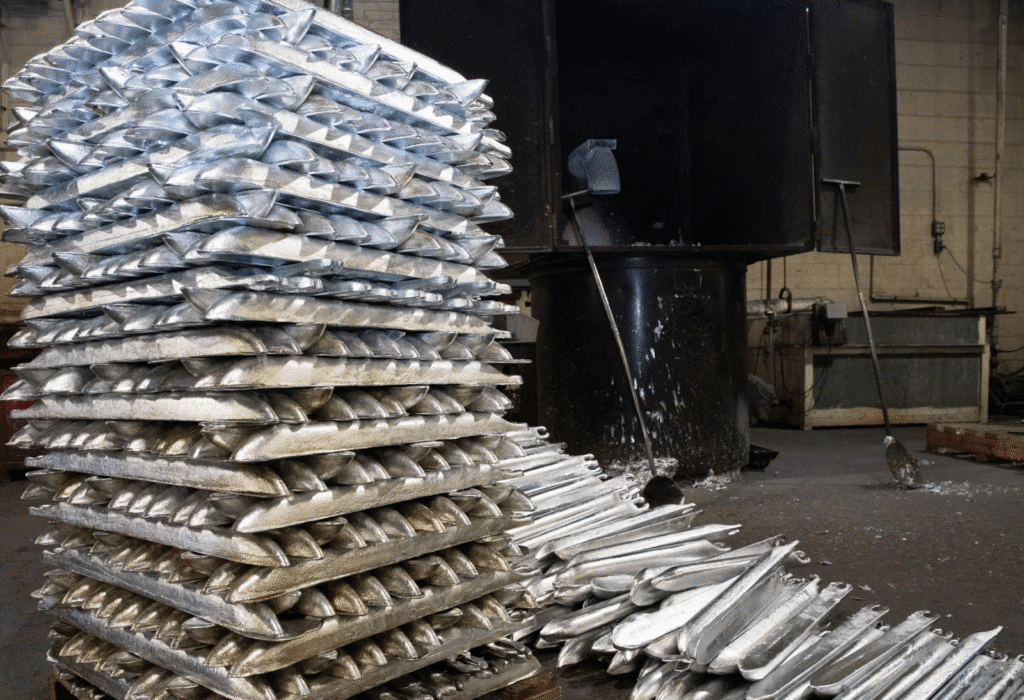
The low melting point (419C) and the small solidification freth that zinc possesses offer a disadvantage to aluminum or magnesium. Molten zinc is used in thin sections and complicated cavities where there is little resistance and minimizes defects caused by flow. The consonance of shrinkage is good and low to favor minimal distortion in the ejection and cooling processes.
Quick solidification of dimensions is made possible through rapid solidification, and highly accurate shot control is possible through the hot-chamber process (used in zinc). These are put together in achieving high repeatability- commonly without machining. To further compare, here is the reason as to why zinc die casting is more precise as compared to aluminum.
Factors of Process Which Directly Affect the Control of Tolerance.
The tolerances depend on injection consistency, thermal balance and cycle repeatability to determine whether the shots will be shot after shot. Changes in plunger speed, die temperature, (±510 o C) changes, see why zinc die casting is more accurate than aluminum.
Process Factors That Directly Influence Tolerance Control
The die is the foundation. Traditionally machined cavities (usually tool steel, H13) have very tight tolerances, but as they heat up, they wear at openings, and at parting lines, they wear away with time, due to thermal expansion, wear, and flash. They need to be heated all over and serviced in terms of frequent polishing/refurbishment.
In hot-chamber zinc casting, precise metering and fast cycles help, but uncontrolled factors like die heating/cooling imbalances still creep in. Learn more in our guides: the zinc alloy die casting process explained, hot chamber die casting for zinc alloys, and key parameters affecting zinc die casting quality.
Tooling Precision and Its Role in Tolerance Stability
Skilled stores also make an emphasis on process checks but not on final inspection. Die temperature, injection pressure and cycle-time are monitored by real time sensors. The charts used are known as statistical process control (SPC), in order to monitor the key dimensions; parameters readjust through the feedback loop before the variation goes out of control.
| Tooling Factor | Influence on Tolerance | Risk if Uncontrolled |
| Cavity machining accuracy | Sets baseline; ±0.01 mm typical | Starting variation carries through production |
| Thermal expansion/contraction | 0.01–0.03 mm shift possible | Uneven die temps cause distortion |
| Shutoff/ parting wear | Loosens fit over 100k+ shots | Flash, mismatch, wider tolerances |
| Maintenance schedule | Refurbishment restores precision | Gradual drift leads to out-of-spec trends |
How Manufacturers Control Tolerances in Production
Skilled stores also make an emphasis on process checks but not on final inspection. Die temperature, injection pressure and cycle-time are monitored by real time sensors. The charts used are known as statistical process control (SPC), in order to monitor the key dimensions; parameters readjust through the feedback loop before the variation goes out of control.
The loop is closed by tooling checks and preventive maintenance. Such an upstream emphasis is much more effective than bad parts sorting.
Common OEM Misconceptions About Tolerances
Most teams believe that closer tolerances are necessarily a good idea, or they can resolve their problems after the cast has been machined. Practically, over-specifying tolerances increases the costs – shorter die life, fewer adjustments, increased overhead on inspection – are of no functional use. All features do not require the same tolerance and standardised specs are myopic and disregard geometry.
When Secondary Machining Is (and Isn’t) Necessary
Ultra-tight bores, threads or mating surfaces ( -0.01 mm) are sensible to machines. However, Zinc itself has a net-shape economics indicating that zinc as-cast accuracy destroys it, with most features. Zinc is a thin-wall material, and can be used at details, but adding machining will nullify these benefits–selectively.
Conclusion — Tolerances Are Controlled, Not Demanded
Tolerances on zinc alloy die casting are not accolade lines that you order on a print and intend to receive, when you demand a print. They are designed as a result of predictable processes, quality equipment and rigorous thermal control. The OEM-supplier relations are most successful when based on practical specifications, joint work on the manufacturability of the design, and understanding of the source of variations. With both parties concentrating on control, but not correction, delivery of parts is steady, expenses are predictable, and projects are not subject to tolerance overruns.