
Both Zamak 3 and Zamak 5 may not be universally the best zinc alloy to die cast, although the correct choice will always be a function of the functional requirements of your part, Die loading, tolerances and finishes required. Most OEM engineers will fall to the highest value on a spec list and the greater the number, the more he/she assumes the higher the performance. As a matter of fact, zinc die casting is a trade-off: seeking greater rigidity using Zamak 5 sometimes implies tolerating a bit lower fluidity, increased wear causing faster mold wear during long production runs, and difficulties in obtaining the smoothest as-cast surfaces or the tightest dimensional long-run control.
This has been the case in more than 10 years of operation production in large volumes of zinc die casting. Zamak 3 continues to be the material of choice in most of the parts since it can provide trusted and repeatable outcomes in the process of casting, machining, and finishing. Zamak 5 is used when it is actually necessary (either because of the design or due to physical characteristics of the alloy) that the material have an additional tensile strength or hardness, such as threaded inserts that are broadly subjected to torque or moderate mechanical loads (brackets).
The two commonly used zinc die casting alloys are Zamak 3 and Zamak 5 which are optimized with different performance priorities;—Zamak 3 is focused on casting stability and performance, as well as surface quality; Zamak 5 is high strength and rigidity in functional parts.
Working with established zinc alloy die cast services when alloy choice is connected to the overall zinc alloy die casting services so the material can be suitable to the design, as well as the manufacturing reality.
What Are Zamak 3 and Zamak 5?
Zamak 3 and Zamak 5 are part of the Zamak family of zinc-aluminum-copper-magnesium alloys that were designed to be cast by die casting in hot chambers. In North America and much of the rest of the world the standard prevailing industry is Zamak 3, whereas in Europe and where greater mechanical robustness is required, Zamak 5 is more extensively used.
The main distinction is a reduction in the copper content: Zamak 3 maintains copper content extremely low (below.03%), and in comparison, Zamak 5 includes 0.711% copper. That little addition increases strength and hardness at the expense of ductility and has some impact on castability.
Here is an unmistakably close view:
| Property | Zamak 3 | Zamak 5 | Typical Applications (Zamak 3) | Typical Applications (Zamak 5) |
| Chemical Composition | Zn ~96%, Al 3.8–4.2%, Cu <0.03%, Mg 0.035–0.06% | Zn ~95%, Al 3.8–4.2%, Cu 0.7–1.1%, Mg 0.035–0.06% | Decorative hardware, electrical housings, consumer fittings | Automotive brackets, lock components, stressed fasteners |
| Industry Adoption | Dominant in North America (70%+ of zinc die castings) | Common in Europe, functional/structural parts | Plated cosmetic parts, toys, connectors | Machinery housings, threaded features, wear-resistant items |
| Key Strength | Excellent castability & stability | Higher mechanical performance | High-volume, tight-tolerance non-structural | Load-bearing or mechanically stressed parts |
To explore all the possible varieties of Zamak (which includes Zamak 2, 7, etc.) in detail, check our guide on zamak alloy grades.
Mechanical Property Differences Between Zamak 3 and Zamak 5
Zamak 5 is always stronger and harder although the ductile is compromised that is, it is less able to stretch and break.
Implication in the field: Zamak 3 is more resistant to impact or some amounts of occasional deformation and Zamak 5 is more resistant to permanent deformation under constant loads.
Common as-cast characteristics (means of industry values):
| Property | Zamak 3 | Zamak 5 | Practical Meaning for Parts |
| Tensile Strength | 283–328 MPa | 328–331 MPa | Zamak 5 handles ~10–15% higher pulling forces |
| Yield Strength (0.2% offset) | 221–295 MPa | 228–295 MPa | Zamak 5 better resists onset of plastic deformation |
| Elongation | 10–11% | 6–7% | Zamak 3 more forgiving in bending/crimping ops |
| Hardness (Brinell) | 82–83 | 90–92 | Zamak 5 offers improved scratch/wear resistance |
| Shear Strength | ~214 MPa | ~262 MPa | Zamak 5 stronger in threaded or riveted joints |
If you’re evaluating high-strength zinc options beyond standard Zamak, see how EZAC vs zamak alloys stack up for even tougher requirements.
Castability, Surface Finish, and Tool Life Considerations
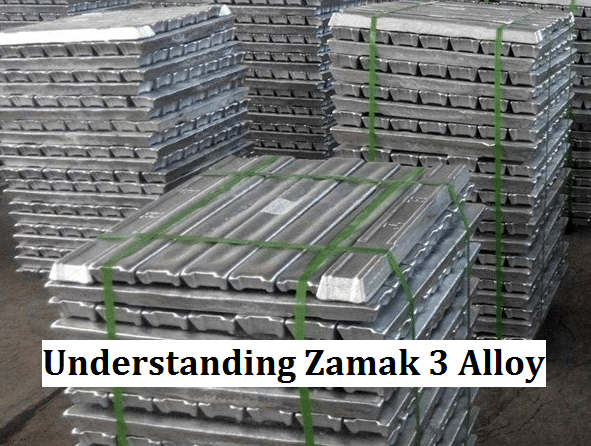
With regards to production floor analysis, the Zamak 3 is more liberal in the hot chamber process as it fills in the thin walls and the finer details under less pressure and fewer defects. The reduced fluidity of Zamak 5 is a few percent more than that of Zamak 2, which may be compensated by a few percent of difference in the design of gates or, in cases like dies over millions of cycles, by its being a bit more aggressive.
Surface finish is no exception: Zamak 3 is frequently smoother as-cast, plating or polishing it is therefore more uniform and less expensive. Zamak 5 is also capable of superb finishes although it might require some adjustments to prevent small porosity in complicated forms.
Comparison at a glance:
| Aspect | Zamak 3 | Zamak 5 | Production Impact |
| Fluidity | Superior | Good (slightly lower) | Easier thin-wall & detail filling with Zamak 3 |
| Casting Stability | Excellent | Very good | Fewer rejects, tighter process windows in Zamak 3 |
| Surface Quality | Smoother as-cast | Good, but can show more texture | Better for high-end plating/finishing |
| Tool Life Impact | Lower mold wear | Slightly higher wear | Longer die life in high-volume Zamak 3 runs |
These factors compound over long production runs—see more in our post on alloy selection in zinc die casting.
When Zamak 3 Is the Better Choice
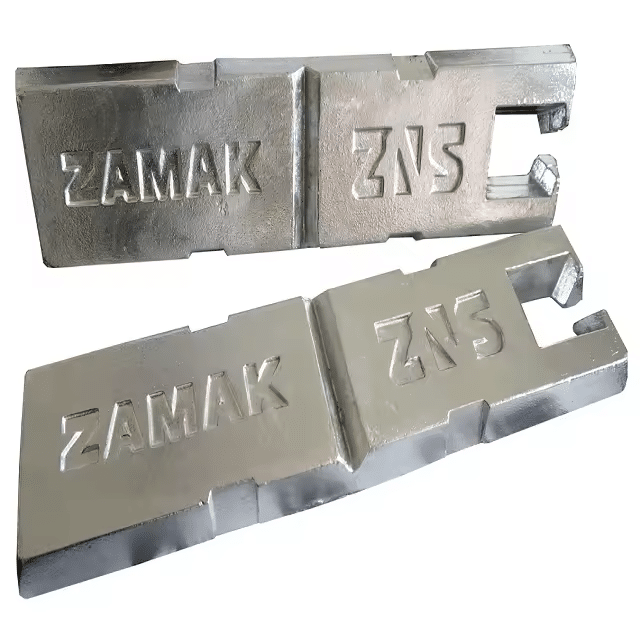
In essence, Zamak 3 is favored in most of the zinc die cast components since its balanced features reduce surprises when it comes to ramp-up and full production.
It’s the clear favorite when:
- Handles, knobs, bezels and similar parts are mostly aesthetic.
- Efficiencies of high-volume production require process stability.
- Strict tolerances and permanence of dimensions are the most important.
- The surface finishing such as chrome plating, powder coating or electropolishing are paramount.
The predictability of our Zamak 3 roof rack bracket or enclosure housing is the direct reason that many of our automotive and electronics customers have continued to stick with the product due to its ability to produce consistent outcomes, though without over-engineering the material. Learn the basics in how zinc alloy die casting works.
When Zamak 5 Is the Better Choice
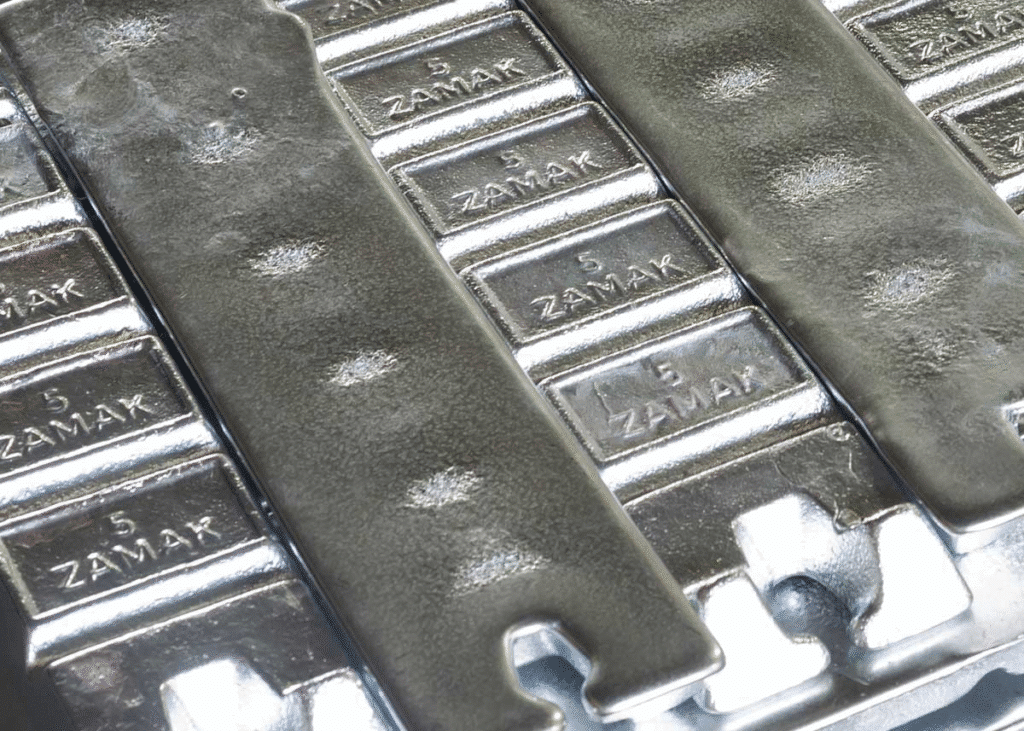
Use Zamak 5 with real mechanical work so that the additional strength is worth the trade-offs.
Common scenarios include:
- Pedals, housings or load bearing brackets.
- Components having threaded applications or press inserts that are under torque.
- Components with increased rigidity required to counter flex or creep.
- Wear resistance Uses where increased longevity is needed.
We have manufactured Zamak 5 lock mechanisms and automotive pedal parts in which the increased hardness and shear strength became an appreciable operating in the field.
To gain accuracy of threaded processes, see further on. zinc alloy for threaded parts.
Process and Accuracy Implications
The alloys are both easily processed in conventional hot chambering equipment, whereas Zamak 3 demonstrates a higher general process tolerance, lower sensitivity to temperature variation, higher reproducibility shot-to-shot, and higher long-run dimensional holding capability through its lower creep propensity.
Zamak 5 also is capable of maintaining very small tolerances, and might need additional care in temperature monitoring of the die itself and the shot parameters to prevent small variances.
Quick process comparison:
| Aspect | Zamak 3 | Zamak 5 | Implication |
| Hot Chamber Suitability | Excellent | Excellent | Both ideal for hot chamber |
| Dimensional Repeatability | Superior | Very good | Zamak 3 holds ±0.001–0.002″ easier over time |
| Process Sensitivity | Lower | Slightly higher | Zamak 3 more forgiving for high-volume stability |
Zinc’s hot chamber advantage is key—contrast with hot chamber vs cold chamber die casting. And for why zinc beats aluminum on precision, see zinc die casting dimensional accuracy.
Common OEM Misconceptions About Zamak 3 vs Zamak 5
One of the assumptions that we come across a lot: “Greater strength should lead to greater overall performance. Not in zinc die casting—real costs in castability, ductility and even finish uniformity accompany extra-strength in copper.
Another: “One alloy to all zinc parts. Actually, excessive specification of Zamak 5 to non-loaded components increases material cost and wear of the mold, but does not add any value.
Lastly, alloy effect on instrumentation and on second operations is underestimated frequently, and in an ultra-high-volume approach, the life of the die might be reduced by going with Zamak 5, or the plating technique might be complicated without early surface quality control.
Conclusion — Choosing the Right Zamak Alloy Is a Design Decision
Finally, it is not a matter of one alloy being better than another when it comes to choosing between Zamak 3 and Zamak 5 it is a matter of the alloy to the real-life needs of the part. Put primacy to castability, surface quality, and stability in production? Zamak 3 usually wins. Require evident increase in strength, hardness or rigidity to perform functionally? There is where Zamak 5 fits its share.
Trade-offs should be evaluated as early as in design with the most favorable results obtained through evaluating load cases, load tolerance, finishing plans, and volume projections. In that manner, the manufacturing process is facilitated (not opposed) by the selection of materials.