
Most of the teams end up having dimensional problems when machining die cast parts in CNC machines and the cause is always the machine and/or a tool. It is far too frequent that the issues can be explained as being caused by datum logic that seemed to make sense on the drawing, but was not able to reflect the actual circumstances of cast surfaces. Die cast parts pose special problems with draft angles, inconsistency in shrinkage throughout the component, mismatched parting lines, and inconsistency in as-cast surface, and make traditional datum considerations of solid-stock machining ineffective.
There is the old fallacy still in existence: when there is a datum absolutely defined on the engineering print, it will automatically provide a fixed point of manufacture. As a matter of fact, it is often an invalid assumption when you deal with castings. Sound datum choice can guarantee that the practical accuracy fits during CNC machining, checking and assembling, not in the paper.
In CNC machining of die cast parts, datum choice determines the way in which the accuracy is passed on in the manufacturing system rather than the method of measuring the parts.
Why Datum Selection Is a System-Level CNC Machining Decision
Datum selection is not just a GD&T exercise, it is a strategic decision which has the whole manufacturing process working. Inspection datums (to check whether the part has been made to design intent) have a fundamental difference with manufacturing datums (to put the part where each operation is needed). Unless these two are properly aligned, there is invariably some variation which will slip in even when all the individual tolerances have been actually satisfied.
Bad datum selections have trickle-down impacts. A loose primary datum could permit the component to roll around in the fix and move following features by a couple of thousandths. That change even multiplies by Multi-operation configurations making viable single-feature tolerances out of control in-of-spec assemblies.
When discussing system-level accuracy transfer, our approach emphasizes high-precision CNC manufacturing built around robust datum strategies that minimize these risks from the start.
Functional Datums vs Nominal Surfaces in Die Cast Parts
Flat as-cast surfaces frequently induce the instinct in engineers to declare them as primary datums, and they can hardly provide the stability required in repeatable CNC arrangements. Draft angles (usually 1-3 degrees per side) imply that these surfaces are not actually flat through the entire part and the contraction is not linear – the thicker parts cool at a slower rate and contract more than the wall. The result? Tilt or translation can be brought in with what appears to be nominal on the print when clamped.
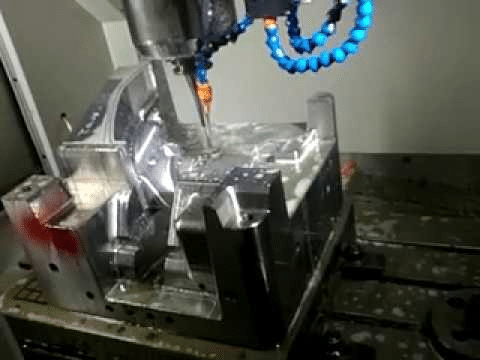
Depending on the end-use performance of the part, functional datums must emphasize surfaces or features that can be related to performance directly such as mating interfaces, bolt patterns, or alignment features and not cosmetic exteriors. This fact-based practice minimizes variability that is brought about by the factors in the casting processes.
The following is a brief comparison between common datum selections:
| Datum Type | Typical Source | Manufacturing Risk | Recommended Use Case |
| Cosmetic surface | External face, non-critical | High variability from draft & shrinkage | Avoid as primary/secondary datums |
| Functional interface | Assembly/mating surface | Low variability if machined or controlled | Preferred primary datum when possible |
| Machined reference | Secondary CNC operation | Controlled, repeatable | Ideal for tertiary or downstream setups |
Use of machined or near-net functional features as datums wherever possible offers a remedy to the variation in as-cast to the tight tolerances needed in finished parts.
Datum Strategy and Engineering Change Responsiveness
Clear datum strategy serves like a shock absorber of engineering changes. With datums directly related to functional interfaces and not arbitrary as-cast characteristics, resets of a dimension, or tolerance may require very little work of a fixture or program modification.
Misunderstood or unstable datum logic, however, transforms even small ECNs into big ones such as creating new setups, requalification runs, and long-lasting validation. Function-based and stable datums allow quicker adjustment in processes as the reference framework is the same even when the position of features changes marginally.
In engineering projects that require quick iteration, a thoughtful datum approach directly improves engineering change response time.
How Datum Selection Influences CNC Scheduling and Process Flow
Datum-dependent arrangements are determined by the flexibility with which a shop orders jobs. Components dependent upon one, weak as-cast datum typically require specific fixtures and limit multi-part production, lowering the use of machines. Conversely, solid datum practices bring faster conversion and improved response to handled orders.
Re-clamping onto floating datums contributes to handling time, opens up chances to error and also increases the lead time. The stores where datum reflections are optimized on process flow have a clear-cut scheduling and forecasted throughput.
This becomes especially noticeable in volume production, where the CNC scheduling impact can make or break on-time delivery.
Integrated Datum Logic Across Casting and Machining
Datum decisions will not exist between the die casting and the CNC phases. When machining is not based on the natural references of the casting (parting line orientation, ejector pin marks or cored features used to provide stability to the mold), downstream arrangements are contending with natural variation.
Maximum consistency is achieved when data logic sequence is not interrupted: the casting of datums is used to start major features of the CNC locating, which get passed on to machined datums to be completed. Neglecting such matching will lead to tolerances in the stack-up of the tolerances, which cannot be completely adjusted by the precision machining.
The success of projects that have teams that actively consider casting and CNC as connected processes- perhaps the reason why divorce is problematic is explained at length in the discussion of integrated casting and machining.
Datum Selection and Axis Configuration in CNC Machining
The datum used has a direct bearing on the ability to make a part function effectively on 3-axis equipment or the possibility of having to use 4-axis (or more) capacity. One of the first data that enables the part to be reversed and re-clamped has opened the possibilities of 3-axis machining with fewer setups that maintain accuracy due to less handling.
Datums that demand repeated re-orientations on the other hand bias towards 4-axis to preserve feature relationships without disrupting the reference chain. The decision does not only impact the cycle time but also cumulative error due to repeated locating.
On-the-job examples indicate the definite supremacy in 3-axis CNC machining versus 4-axis CNC machining, 3-axis vs 4-axis CNC machining depending on datum strategy.
Datum Continuity in Multi-Operation CNC Machining
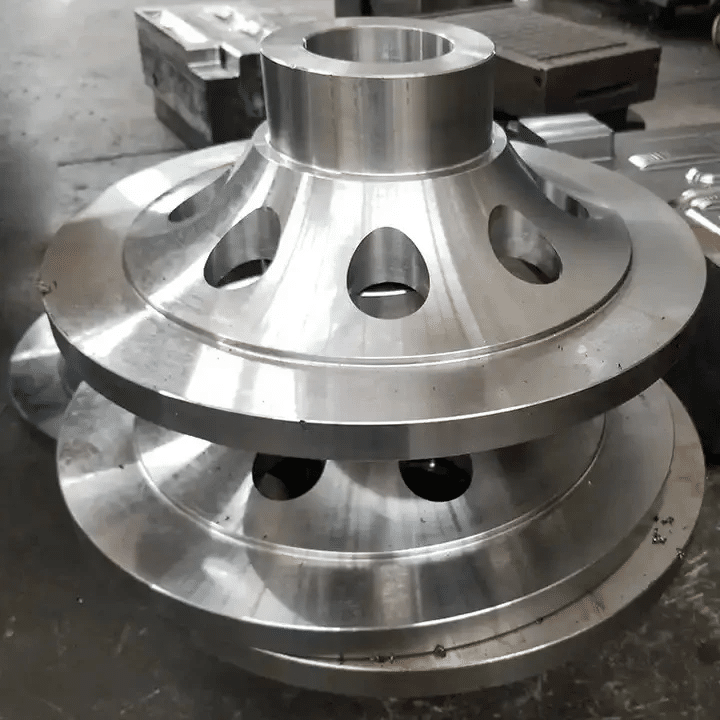
Datum drift is among the most insidious effects on dimensional integrity in those areas of production where numerous CNC operations are required, all of them demanding that the machine works from a common datum. In every re- setup, there is a possibility of slight variations e.g. thermal expansion or wear of the fixtures or operator differences which add up unless datum handoff is stated expressly.
In a sound datum continuity plan intermediate machined features are approached as good handoffs: rough a plane or bore a stable and then use the result as a handoff of the second operation. This maintains the original referencing trail and brings variability within check even when it comes to large scale productions.
When multi-operation CNC machining is a necessity, data continuity can be rewarded with consistency.
Tool Wear, Datum Degradation, and Long-Term Accuracy
The wear of the tool makes its effect not only on the size of the features, but also on the effective datum surface over one production run. When matted datum face is repeatedly used as a locating surface, cutter marks, accumulated edge or micro-chipping can cause tilt or offset which increases with batch size.
The datum strategy should expect this behavior: favour larger contacts, design with wear-resistant features (hardened inserts may be required), or arrange the sequence of operations so that important datums should be completed last. Intensive planning of the wear prevents long-run precision at drift.
Effective tool wear management is directly linked to selecting datums that will not change as tool life progresses.
How Datum Decisions Influence Total Manufacturing Cost
The cost motivation of datum instability is not necessarily easy to see when issuing the quotes. Rework to pursue variation, scrap due to set-up errors, additional inspection time, and qualification accumulates as datums do not offer reliable locating.
Components with considered datum plans experience lower total costing by way of less establishments, less corrections and higher starting yielding. The initial investment in engineering in datum planning, is many times over, paid back in the stability of production.
A strong CNC machining cost strategy begins with ensuring that datum logic has been properly implemented at the very concept development stage.
Conclusion — Datum Selection Defines Functional Accuracy
In CNC machining of die cast components, datum selection defines how precision is produced, passed, and maintained in the production process, rather than the method of its inspection only. It can be treated as a manufacturing decision structure on its own and not a drawing structure and thus renders an upstream approach to operations; where a little decision can avoid a lot of downstream situations.
Through attention to functional interfaces, bringing together the casting and machining reference frames, and by foreseeing variability in the real world, the teams create a process that yields uniform results even when the process is exposed to stress of production. The compensation will be reduced number of surprises, accelerated ramps, and components that work as expected on field.